The Rev. David Silk

The Rev. David Silk died in Torquay in September 2023.

He arrived as curate at the Holy Redeemer Church, Days Lane in 1963 and one of his remits was to develop church life at the ‘tin hut’ in Blackfen Road, opposite Leechcroft Avenue. Regular Sunday services began and there was soon a congregation of 90, packed into the hall with music by a harmonium and piano. The Woodman pub (now the George Staples) played a significant part in church life with meetings and fundraising events held there. The Bishop of Tonbridge was so impressed when he visited that he set aside money to build a new dual-purpose hall and church. Opened in 1967, the choice of the name was left to the people of Blackfen. ‘The Good Shepherd’ was chosen, and The Rev. David Silk became Priest-in-Charge. Fundraising continued in events that involved the whole community.

The picture below left shows Rev. David Silk (right) at the marriage of my Uncle George and Auntie Marion in the grounds of Holy Redeemer in 1963. Below right is The Church of the Good Shepherd building in 2020, with a new housing development already encroaching.

The Rev. David Silk went on to become Bishop of Ballarat in Australia. He was a great help to me in 2014 when I was researching the history of Blackfen. He said: “A few years ago I was in conversation with the man charged with writing my obituary. He asked me, ‘which were the best years?’ I was able honestly to say, ‘Blackfen and Ballarat’. Blackfen was because that is where we had a sense of freedom from stuffiness, where we learned from the companionship of the people with whom we shared the adventure of forming the Church of the Good Shepherd, a church in both senses of the word – a community as well as a building; Ballarat was because it all happened again – the same sense of freedom, of purpose and of companionship.”

When I told him that the future of the Good Shepherd building was uncertain and there was a possibility of redevelopment, he said: “At the very least I hope that it will be for the provision of affordable housing for which there is a desperate need right across the country.”

The Rev. Mgr David Silk, 1936-2023.
The Legacy of Slavery

Yesterday I visited the ‘Slavery, culture and collecting’ exhibition at the Museum of London Docklands which investigates the relationship between European culture and transatlantic slavery. It’s an uncomfortable truth that many ‘philanthropists’ commemorated for their associations with charitable causes generated their wealth from slavery.

And Blackfen is directly affected by this. Danson House was the lavish country home of Sir John Boyd who owned sugar plantations on St Kitts. He acquired the freehold of Danson Hill in 1759, had a new Palladian villa built and set about greedily acquiring parcels of land to enlarge his estate to display his wealth and social status – this took the boundary up as far as Westwood Lane and south of Blackfen Road, including the cottage which became the ‘Chapel House’. He travelled abroad, purchasing works of art for his villa. In later life he focused ‘on religious subjects and good deeds and administering local charities’.

007

Neill Malcolm inherited the Malcolm family fortune made in Jamaican sugar plantations and through marriage inherited Lamorbey House (now Rose Bruford College) in 1812. He extended Lamorbey’s estate by buying up surrounding parcels of land. The Malcolm family went on to endow the chapel at Holy Trinity, provided land for a new vicarage, supported the church school in Hurst Road, established another school in Burnt Oak Lane and built cottages for workmen. Although the family moved away from the area, it was Lt-Col G. I. Malcolm of Poltalloch, a descendant of the Malcolms of Lamorbey, who laid the foundation stone for the Church of the Good Shepherd in Blackfen Road in 1967.

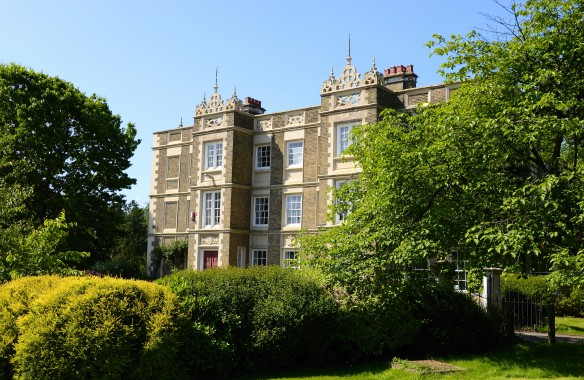
Lamorbey House

The history of the Lamorbey Estate is closely intertwined with the history of Blackfen.

In 1608 the Goldwell family’s Lamorbey estate included a 54 acre farm at Blackfen. This later got passed around as fortunes rose and fell. In the 18th century landowners bought up parcels of land to convey their wealth, political power and social status. William Steele enhanced his Lamorbey estate by buying up land in Blackfen in 1745. But it worked both ways: when Robert Owen Jones died and his Blackfen home was put up for auction in 1861 a key selling point was the fact that the property adjoined big estates like Lamorbey and Danson. Estate agents were at work even then!

And when Blackfen’s Church of the Good Shepherd was built in 1967 it was Lt-Col G. I. Malcolm of Poltalloch (a descendant of the Malcolms of Lamorbey) who laid the foundation stone.

The Grade II listed Lamorbey House (now the home of Rose Bruford College) is open to visitors as part of Open House next Saturday 22 September 10am-3pm. https://www.bruford.ac.uk/news-events/events/lamorbey-house-part-of-open-house-london/

Lamorbey_House