Public air raid shelters in Blackfen

During 1938/39 there was a real fear by the authorities that if war broke out, bombing raids would cause mass casualties. Trenches were dug in parks to protect the public if they were caught out in a raid and couldn’t get to their own shelters.

Trenches were dug at right angles to each other, with earth walls reinforced with sandbags and a corrugated iron roof covered with a layer of soil. The roof was raised about a foot above ground level. They were not particularly safe. A direct hit or even a nearby bomb would probably collapse the whole shelter. They were also very unpleasant – smelly, unsanitary and waterlogged.

By October 1939 there were public shelters built or planned at The Oval, Penhill Park, Marlborough Park, Holly Oak Park and Willersley Park. The shelter at The Oval was designed for 316 people, but it immediately flooded and extra drainage had to be constructed. However, it seems no-one ever actually used the shelter during air raids. In Blackfen, people tended to have gardens with Anderson shelters (or if not, Morrison shelters), so they were much less likely to have to use public shelters in parks, unlike in London where most people didn’t have gardens. And most shelters dug in the ‘Black Fen’ were never going to be much use as they were often flooded.

As always, vandalism was a problem. There was damage and thefts from trenches in Holly Oak Park on 5 and 6 February 1940. Tools were stolen by five boys who were caught and charged, appearing in court on 20 February.

Today there is no trace on the surface of the trenches at The Oval. The entrance, which would have been in between the two rectangle sections, was blocked up.Oval_google satellite 2018_shelter

The Woodman, 1845-1931

The original Woodman Public House was built by George Staples, a publican and wood merchant, in 1845. At that time there were only nine families living in the hamlet of Blackfen, so he must have been catering for the passing trade on the road from Eltham to Bexley. After his death in 1859 his wife and son took over the running of the pub. There was a tradition that Charles Peace, a notorious burglar around southern London, frequented The Woodman and treated all the customers to a drink. (He was put on trial and executed in 1879).

From 1914 the landlord was John Alfred Harvey, a retired slaughterman who was known for keeping a pet goose. By 1930 it was clear that the old pub no longer met the requirements of the district – farmland was being sold off and hundreds of houses were being built. The new Woodman Inn was built in 1931, erected behind the old one so that business could continue – this explains why the present pub is at an angle facing the crossroads.

Thomas Walter Gwillim

‘Gwillim Close’ is named after Thomas Walter Gwillim. He had been a newsagent in Woolwich but when his father died he had money to buy some land in Blackfen. In 1927 he wanted to build a huge development of houses on the north side of Blackfen Road but planning permission was denied because of access and drainage issues.

Instead he built a row of just seven houses in Blackfen Road approximately where the east part of Wellington Parade is now. He moved into one which he called Gwenlliant (after his sister), and this is the only one which survives, incorporated into the 1930s Wellington Parade. Its roof can be seen above the shop roof line.

For some years a dilapidated ‘haunted house’ remained where children would explore and scare each other! Gwillim’s land was later sold off but he is remembered in the road name ‘Gwillim Close’.

Michael Heaslip of Blackfen Farm

Michael Heaslip was born in Newmarket, Co. Cork and came to England with his young family in the 1890s. He worked as a haulage contractor in north Woolwich and also ran a pub there with his wife Margaret. He bought a farm in Blackfen as grazing for his horses and liked to use it as his weekend retreat! His granddaughter Kathleen used to help pick the strawberries (which grew where Bargain Booze is now!) and said they were the best she’d ever tasted. As they were Catholics they went to Mass in Sidcup on Sunday mornings, bringing back Father O’Knight for lunch and later playing cards round the dining table.

The farm was sold off for 1930s housing development, but it is fitting that Our Lady of the Rosary Roman Catholic Church was later built on land next to the Heaslip farmhouse. The Catholic Church was in high demand in the 1930s while house-building was active in Blackfen as there was a large Irish population who came to find work.

Cllr John Cronin

John Cronin was one of many people who came to live in Blackfen in 1931. He had lived in Islington but rents there were rising dramatically. At that time there was no Bexley Labour Party group and Cronin became committed to establishing one. This was a time when the trade unions were growing in importance and many of the new residents had an interest in politics.

Cronin became councillor for the Falconwood Ward in 1937 and later for St Michael’s Welling. He worked hard to assist those in need – some people who moved to Blackfen had over-reached themselves and couldn’t afford rents, food or clothing. When Cronin became Mayor in 1947 he and his wife Ellen regularly had to attend ceremonies and dances but they couldn’t afford extravagant clothes and as Mayoress, Ellen held her ‘at home’ at Danson Mansion rather than at their bungalow.

During the Second World War Cllr Cronin’s home became a centre for the distribution of gas masks and his garage was used by teams of builders repairing house roofs to store their tools. As one of the few people in the area with a telephone, he placed it by an open window so people could stick their hand in and use it. He was an ARP Warden and his duties included enforcing blackouts, directing people to shelters when the sirens sounded, reporting bombings and helping with the aftermath of an air raid.

John Cronin died in 1986 aged 84.

ARP warden recruit

Listed buildings of Blackfen

LOCAL LIST

A locally listed heritage asset is a building or structure which is deemed to be of local architectural or historic interest and is included on the local heritage list drawn up by Bexley Council. There are several in Blackfen, and a few just outside which are so close it seemed a shame to omit them here. They make a positive contribution to the area’s local character and sense of place, and they are offered some level of protection by the local planning authority.

177-179 Blackfen Road (corner of Burleigh Avenue). Known as Westwood Cottages, or Maxwell’s Cottages, they were built in 1890 to house workers on Westwood Farm. A footpath led to the farmhouse which was at the site now occupied by the children’s playground at The Green.

George Staples pub, 271 Blackfen Road (formerly The Woodman). Built in 1931 by the architect, Kenneth Dalgliesh, it replaced an earlier pub on the site.

Edward VIII pillar box, Tyrrell Avenue. Only a small number of letter boxes were made during the short reign of Edward VIII in 1936 and after his abdication, most boxes bearing his cypher were modified or replaced. So a surviving one is a rare sight.

ARP warden’s shelter, Wellington Avenue, near The Oval. Used during the Second World War as part of a network of shelters for ARP wardens.

The Three Blackbirds pub, 118 Blendon Road. Licensed as far back as 1717, it was rebuilt after being gutted by a fire around 1900.

Blendon Lodge, 167 Blendon Road. The West Lodge, built in 1855/56 stands at the corner of Blendon Road and The Drive. It had four rooms and a garden and housed various staff of Blendon Hall which was demolished in 1934. (The East Lodge, built at the same time as the West Lodge, was at the corner of today’s Beechway and was demolished in the 1930s).

STATUTORY LIST

Listing of a building or structure on the national Statutory List marks and celebrates a building’s special architectural and historic interest, and also brings it under the consideration of the planning system, so that it can be protected for future generations.

The Chapel House, 497 Blackfen Road – Grade II listed. Decoration giving the impression of a ‘chapel’ was added to the cottage when John Boyd of Danson acquired the parcel of land on which it was sited.

Jay’s Cottages, 1, 2, and 2a Blendon Road – Grade II listed. Jay’s Cottages, originally known as Blendon Villas, have stood in Blendon Road since the early 18th century to house workers on the Blendon Hall estate. They still have a lack of rear windows which was intended to stop the inhabitants gazing over the grounds of the Hall and invading the privacy of the Hall’s wealthy residents!


Smartening up nicely

At 10am on Saturday 22 April a group of volunteers met to paint the railings and weed the pavement along Woodman Parade in Westwood Lane, Blackfen. We were joined by Rt Hon. James Brokenshire, MP and Councillors Louie French, Cafer Munur and Lynn Smith. Despite the rain (how unlucky!) we carried on and it has made such a difference in just a couple of hours.

Thank you to Raw Hair Salon for the tea/coffee and biscuits! We will return soon to continue the job.

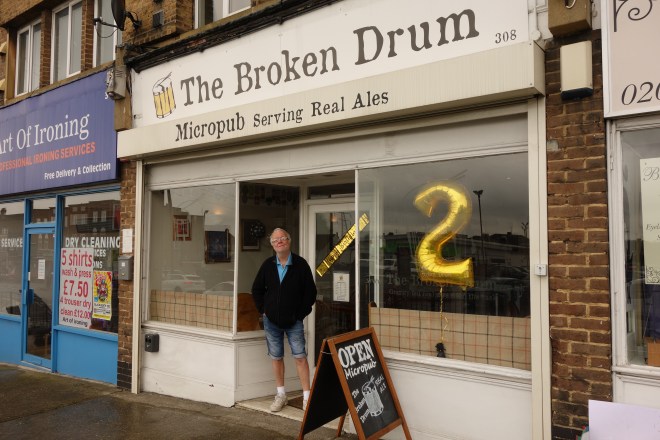
And happy 2nd birthday to The Broken Drum!

DSC08607

Southeastern: the future

Southeastern has published a consultation document ‘Shaping the Future’. At 46 pages long you would be forgiven for missing the lines on page 23 which say: “There would be a limit to the improvements that could be made to the timetable without also reducing the number of central London stations served from certain locations at particular times. An example might be for all Metro services on the north Kent (between Dartford and
Charlton), Greenwich and Bexleyheath lines to terminate at Cannon Street only. We believe that the simplicity of a regular service to a single London terminal throughout the day would benefit both regular and occasional passengers.”
If you travel on the Bexleyheath line to Charing Cross or Victoria you would be advised to complete the online survey as a response to this consultation. The DOCUMENT is here: https://www.gov.uk/…/south-eastern-rail-franchise-public-co…. The SURVEY is here: http://www.smartsurvey.co.uk/s/QHQQM/

There is also an online petition https://petition.parliament.uk/petitions/190894 but the important thing is to complete the survey and make your feelings known.

Blackfen Community Easter Event

Come along to Blackfen on Saturday 8th April 10am-2pm for free children’s activities and raffle.

There will be 400 Easter Eggs to give to the first 400 children (with parent/guardian) who take part in a fun word search game. Go to Blackfen Community Library between 10am and 2pm to pick up your sheet, then visit Blackfen’s shops to collect stamped letters to complete a phrase. Return to the library afterwards to collect your egg! You could also win a prize in the raffle!

There will be farm animals and local emergency services at the Co-op car park, and the George Staples pub will have a bouncy castle.

The event has been organised by Hilary Maile of Shimmer Salon. Thanks to all the traders for taking part in the game and providing raffle prizes. Thanks also to the generosity of local councillors who have contributed the full cost of all the Easter eggs.

Easter 2017