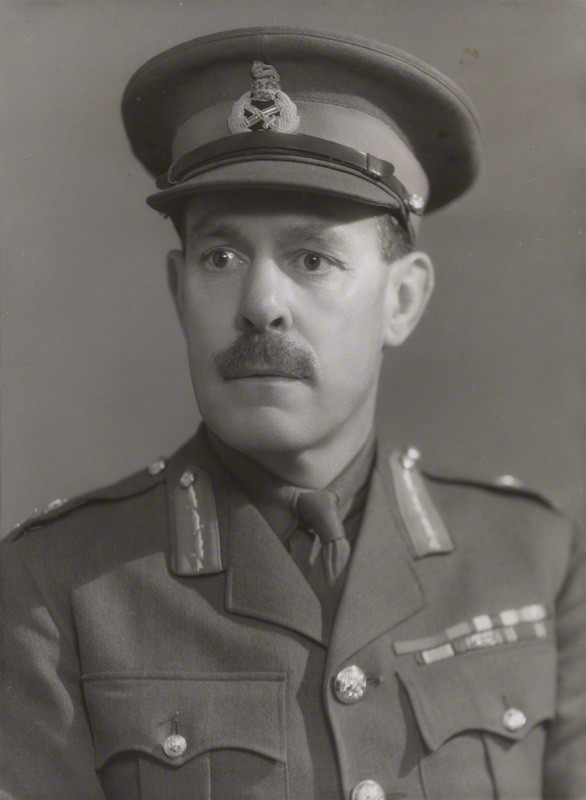
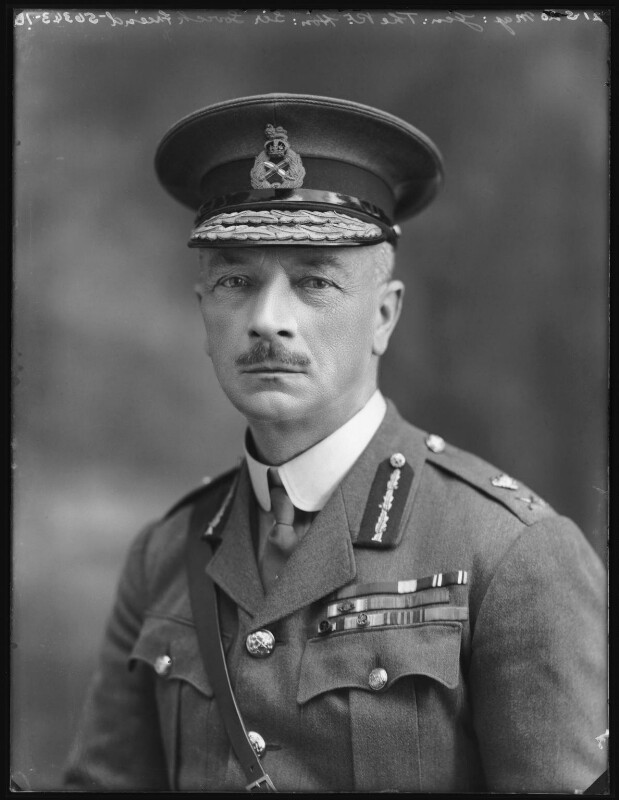
Major General Lovick Friend of Penhill

Apart from being extremely local to Blackfen, my interest in Penhill was sparked because of the Friend family who lived there in the 1840s and 50s, and specifically an individual called Lovick Bransby Friend.

While researching my family history some years ago I discovered that my great aunt’s brother-in-law was present at the GPO in Dublin for the Easter Rising in 1916. Timothy Tyrrell had the strong belief that Ireland should be independent and he was one of the ‘Maynooth Fifteen’ who marched to Dublin in April 1916 to join the fight. He later fought in the War of Independence and the Civil War. Unsurprisingly, this was never talked about afterwards and it was lost to family memory.

Irish history is something we are not taught about here in Britain, shamefully, and while I was finding out about what happened, I saw that the Commander-in-Chief of Ireland, appointed in 1914, was Major General Lovick Bransby Friend. Some online references state ‘Halfway Street, Sidcup’ as Friend’s birthplace which is wrong, but this intrigued me to find out more.

Lovick was born on 15 April 1856 and baptised on 27 June at Holy Trinity, Lamorbey. He was the son of Frederick and Fanny Friend who lived at Penn Hill. His father’s occupation according to the 1851 census was ‘ale and beer agent’. His eldest brother Frederick Tyrrell was baptised on 26 September 1849 and other siblings followed: William Beauchamp, Charles Arthur, Fanny Cooper, Ella Harriet, Edward Coke, George, Astley, Frances and Mary. Living with them in 1851 were a nurse, house maid, cook and groom who came from as far afield as Suffolk, Wiltshire and Devon. By the 1861 census the Friend family was living at Woolett Hall, North Cray (later renamed Loring Hall) and had added two footmen to their list of servants.

Lovick Bransby Friend had left the family home to receive his education at Cheltenham College (where he is shown on the 1861 census, aged 14), followed by the Royal Military Academy Woolwich. He was commissioned into the Royal Engineers, serving in Hong Kong, Egypt and Sudan and was showered with awards and medals.

As Commander-in-Chief of Ireland in 1916, following the arrest of Roger Casement for bringing weapons to Ireland, Major General Friend was satisfied that any danger had passed and went on leave to England. This was a grave error of judgement and when the Rising broke out on Easter Monday 24 April 1916, he was in London. He returned to Dublin but was replaced as Commander-in-Chief when Sir John Maxwell arrived on 28 April. Friend was quietly retired a few years later.

I was drawn to compare the two men, Timothy Tyrrell and Major General Lovick Friend. Timothy was a keen sportsman (hurling and football) as was Friend (cricket and football). But there the similarities end. Friend had lived a privileged life: his home, his education, freemasonry, his commission into the army, medals and a knighthood, and a comfortable retirement despite a huge error of judgement. Timothy Tyrrell was born in a tiny old cottage in the poor end of the town of Maynooth in Co. Kildare, Ireland. As a Catholic, his family and neighbours had suffered centuries of repression from the British. He felt so strongly that he was prepared to risk death for his belief in Irish independence. While he was eventually released from prison (and narrowly missed death by hanging) he was ostracised and unable to find work afterwards, and it was only very recently that the men and women who took part in the Rising were seen as ‘heroes’. There is now a memorial to the Maynooth Fifteen in the town’s square.

In a strange twist, Major General Lovick Friend’s mother’s maiden name was Tyrrell, and her grandfather and brother were both named Timothy Tyrrell.

My great aunt Lizzie moved to London to find work when her husband (Timothy’s brother, Jack) died in Ireland in 1943. Her sister – my grandmother – spent the last years of her life in Blackfen, just 10 minutes’ walk from Penhill where Lovick Friend was born. Life is full of coincidences!
The Lemon Well at Avery Hill

Lemonwell Drive is named after the ‘Lemon Well’ which was a bricked well beside the road from Avery Hill to Eltham. At one time it had a reputation for its medicinal properties and was used for ‘affectations of the eye’. The spring which supplied the well was in the grounds of Lemon Well House, occupied by Major Sir Harry North, son of Col John Thomas North of Avery Hill.

Born in Leeds in 1866 and educated at Cambridge, Harry served in the Royal Munster Fusiliers. He was knighted in 1905 for his military service. He married Jessie in 1894 and they lived at Lemon Well with their three children, a butler, cook/housekeeper, housemaid, kitchen maid, nurse and ladies’ maid.

The house was sold after his death in 1920 and divided into three units. But in 1961 it was demolished and twenty-four flats were constructed in its place.

This part of Bexley Road, between Avery Hill and Eltham, still has a rural feel to it.

Col North: mechanic to millionaire

Avery Hill Mansion and the Winter Garden were created by Col John Thomas North ‘Nitrate King’ in 1890. But he didn’t get long to enjoy his house, as he died suddenly in 1896. In his obituary he was described as “a solid, sturdy Yorkshireman, shrewd, honest”.

John Thomas North was born in Leeds in 1842 and was apprenticed to a machine manufacturer. He was sent to South America to superintend machinery there. While there he found vast deposits of nitrate of soda and he realised the commercial value of this as fertiliser. This made him very wealthy. On his return to London he became a familiar face in the City, built himself an extravagant house at Avery Hill and became Honorary Colonel of the Tower Hamlets Volunteer Engineers. He had risen from mechanic to millionaire. But his business empire collapsed, and after he died his widow sold Avery Hill.

From Ireland to Blackfen

On St Patrick’s Day, let us remember the most prominent Irishman in Blackfen’s history, Michael Heaslip, who was born in Newmarket, Co. Cork and came to England with his young family in the 1890s. He worked as a haulage contractor in north Woolwich and he bought a farm in Blackfen as grazing for his horses which he liked to use as his weekend retreat! His son, also Michael, served at the Woolwich Arsenal during WWI and his picture (see below) was part of the WWI display at Sidcup Library.
The farm was sold off for 1930s housing development, but Our Lady of the Rosary Roman Catholic Church was later built on land next to the site of Heaslip’s farmhouse. The Catholic Church was in high demand in the 1930s while house-building was active in Blackfen as there was a large Irish population who came to find work.
And when Irish people in Blackfen married their weddings were often announced in Irish newspapers. The Ballina Herald reported on 14 April 1951 the marriage of John Bradley, only son of Mr and Mrs John Bradley, Glasgow, to Breedge, youngest daughter of the late Mr John Granahan and Mrs Mary Granahan, Creevy, Castlehill, Ballina, which took place on Easter Monday at the Church of the Holy Rosary, Blackfen Kent. Meanwhile the Irish Independent of 20 November 1962 p13 reported the marriage (pictured) of Mr Thomas Sullivan, Rosmuck, Co. Galway and Miss Elizabeth Dunne, Sidcup Kent, who were married in the Church of Our Lady of the Rosary, Blackfen, Kent.

Leechcroft in Carshalton

Look familiar? These roads are actually in Carshalton, Surrey. This estate was built by Charles Richard Leech who was also a linoleum maker. He had designed a floor-covering which was of improved quality and cheaper to manufacture than before, and his success meant that he could buy up large areas of land for redevelopment in the early 1930s. In Blackfen he built hundreds of houses on what had been Westwood Farm, Heaslip’s Farm and Queenswood and he also built houses in Old Farm Avenue, Sidcup and the Kingswood Estate in Swanley.

Leech’s 1930s houses and bungalows are still serving us well in Blackfen – although many have been extended and altered, but I would think the original lino flooring in the houses he built is long gone!

Sir Charles Martel visits Sir William Pryn

On this day, 15 April, in 1930 Brig.-Gen. Sir Charles Martel, CB and his wife Lilian, of Queenswood, Blackfen visited the home of Surgeon Rear Admiral Sir William Pryn of 3 Christchurch Road, Sidcup. Martel signed Pryn’s visitors’ book and indicated that the day on which the Martels were themselves ‘at home’ to visitors was Saturday.

In the early 1900s our area was a popular place to live for retired military families. I am always fascinated by the networking and friendships between them!


Thomas Walter Gwillim

‘Gwillim Close’ is named after Thomas Walter Gwillim. He had been a newsagent in Woolwich but when his father died he had money to buy some land in Blackfen. In 1927 he wanted to build a huge development of houses on the north side of Blackfen Road but planning permission was denied because of access and drainage issues.

Instead he built a row of just seven houses in Blackfen Road approximately where the east part of Wellington Parade is now. He moved into one which he called Gwenlliant (after his sister), and this is the only one which survives, incorporated into the 1930s Wellington Parade. Its roof can be seen above the shop roof line.

For some years a dilapidated ‘haunted house’ remained where children would explore and scare each other! Gwillim’s land was later sold off but he is remembered in the road name ‘Gwillim Close’.

Listed buildings of Blackfen

LOCAL LIST

A locally listed heritage asset is a building or structure which is deemed to be of local architectural or historic interest and is included on the local heritage list drawn up by Bexley Council. There are several in Blackfen, and a few just outside which are so close it seemed a shame to omit them here. They make a positive contribution to the area’s local character and sense of place, and they are offered some level of protection by the local planning authority.

177-179 Blackfen Road (corner of Burleigh Avenue). Known as Westwood Cottages, or Maxwell’s Cottages, they were built in 1890 to house workers on Westwood Farm. A footpath led to the farmhouse which was at the site now occupied by the children’s playground at The Green.

George Staples pub, 271 Blackfen Road (formerly The Woodman). Built in 1931 by the architect, Kenneth Dalgliesh, it replaced an earlier pub on the site.

Edward VIII pillar box, Tyrrell Avenue. Only a small number of letter boxes were made during the short reign of Edward VIII in 1936 and after his abdication, most boxes bearing his cypher were modified or replaced. So a surviving one is a rare sight.

ARP warden’s shelter, Wellington Avenue, near The Oval. Used during the Second World War as part of a network of shelters for ARP wardens.

The Three Blackbirds pub, 118 Blendon Road. Licensed as far back as 1717, it was rebuilt after being gutted by a fire around 1900.

Blendon Lodge, 167 Blendon Road. The West Lodge, built in 1855/56 stands at the corner of Blendon Road and The Drive. It had four rooms and a garden and housed various staff of Blendon Hall which was demolished in 1934. (The East Lodge, built at the same time as the West Lodge, was at the corner of today’s Beechway and was demolished in the 1930s).

STATUTORY LIST

Listing of a building or structure on the national Statutory List marks and celebrates a building’s special architectural and historic interest, and also brings it under the consideration of the planning system, so that it can be protected for future generations.

The Chapel House, 497 Blackfen Road – Grade II listed. Decoration giving the impression of a ‘chapel’ was added to the cottage when John Boyd of Danson acquired the parcel of land on which it was sited.

Jay’s Cottages, 1, 2, and 2a Blendon Road – Grade II listed. Jay’s Cottages, originally known as Blendon Villas, have stood in Blendon Road since the early 18th century to house workers on the Blendon Hall estate. They still have a lack of rear windows which was intended to stop the inhabitants gazing over the grounds of the Hall and invading the privacy of the Hall’s wealthy residents!
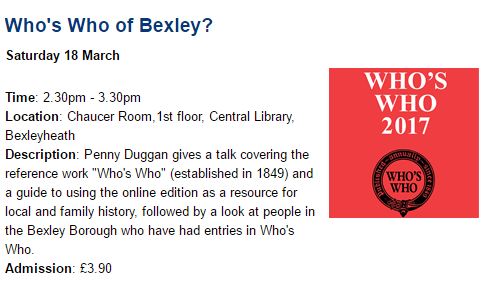
 

Who’s Who of Blackfen

On 18 March I’ll be giving a talk at Bexley Local Studies and Archive Centre on ‘Who’s Who of Bexley’.

Talk advert

Of course I will be including some of the names from Blackfen who have been in Who’s Who.

Sir Vesey Holt, KBE, banker, lived at Queenswood, Blackfen from 1868 and later lived at Mount Mascal in North Cray. There is also Brig.-Gen. Sir Charles Martel and his son Lt-Gen. Sir Giffard Martel who both lived at Queenswood, Blackfen from 1910. Mike Rann lived in Blackfen as a child but emigrated to New Zealand and was Ambassador of Australia to the UK 2012-14. Audrey Slaughter lived in Blackfen as a child and became a writer and magazine editor. George Wallace, MP, later Lord Wallace of Coslany lived in Blackfen and it was his intervention that saved Queen Mary’s Hospital from closure in 1948. And Rev. David Silk who started his career in Blackfen went on to become Bishop of Ballarat in Australia.

To book a ticket and for more information about events at Bexley Local Studies and Archive Centre, see http://www.bexley.gov.uk/archiveevents.


Lt-Gen. Sir Giffard Martel, KCB, KBE, DSO, MC

Giffard Le Quesne Martel, born in 1889, lived at Queenswood House, Blackfen after his family moved there in 1910. After attending the Royal Military Academy, Woolwich he was commissioned into the Royal Engineers. He served in France from 1914 and took an active interest in the development of tanks. After the war he lived in Camberley, Surrey and he built a workshop in his garden where he built a prototype one-man tank which others later developed into the British light tank and machine-gun carrier. He also served in the Second World War in France, India, Burma and Moscow. He was described as “a remarkable officer and constitutionally fearless… a natural bruiser… with a deep hoarse laugh”.

NPG x83846; Sir Giffard Le Quesne Martel by Bassano

Lt-Gen. Sir Giffard Martel (from National Portrait Gallery)

It was when he was back in London in 1944 that he lost an eye in the bombing of the Army and Navy Club. He died in 1958: he was found dead, shot in the head, with the shotgun near the body.

His parents, Brig.-Gen. Sir Charles Martel and Lilian Martel, lived at Queenswood until 1931, when the estate was sold to the housing developer, C. R. Leech.