Who’s Who of Blackfen

On 18 March I’ll be giving a talk at Bexley Local Studies and Archive Centre on ‘Who’s Who of Bexley’.

Talk advert

Of course I will be including some of the names from Blackfen who have been in Who’s Who.

Sir Vesey Holt, KBE, banker, lived at Queenswood, Blackfen from 1868 and later lived at Mount Mascal in North Cray. There is also Brig.-Gen. Sir Charles Martel and his son Lt-Gen. Sir Giffard Martel who both lived at Queenswood, Blackfen from 1910. Mike Rann lived in Blackfen as a child but emigrated to New Zealand and was Ambassador of Australia to the UK 2012-14. Audrey Slaughter lived in Blackfen as a child and became a writer and magazine editor. George Wallace, MP, later Lord Wallace of Coslany lived in Blackfen and it was his intervention that saved Queen Mary’s Hospital from closure in 1948. And Rev. David Silk who started his career in Blackfen went on to become Bishop of Ballarat in Australia.

To book a ticket and for more information about events at Bexley Local Studies and Archive Centre, see http://www.bexley.gov.uk/archiveevents.


Is Blackfen in London or Kent?

Blackfen has for centuries been a small hamlet in the parish of Bexley in the county of Kent.

Administrative changes in 1894 meant that Blackfen became part of the new Bexley Urban District Council but in 1910 the southern half of Blackfen was transferred to Foots Cray Urban District Council, renamed Sidcup UDC in 1921 and in 1934 becoming Chislehurst and Sidcup UDC. In 1965 Blackfen was united once again into the London Borough of Bexley under the London Government Act. Ever since then, residents have argued over whether the Borough of Bexley is part of London or part of Kent.

Many, and perhaps younger generations in particular, identify more with London. If someone asks where I live, I say different things according to who has asked. Sometimes I say south-east London to avoid notions that I live in a picturesque village, but I always feel a terrible sense of disloyalty when I do this. Usually I would instinctively say Kent.

When I commute to central London each day, I do feel that I leave Kent in the morning and return to it each evening. When driving down the Maidstone Road between Ruxley and Swanley and reaching the ‘Welcome to Kent’ sign, I always protest “but I was already in Kent.”

How has this contradiction come about? Since 1965 Bexley has been a London Borough. We are eligible to vote for the London Mayor and part of our council tax goes towards funding the Greater London Authority. Bexley is under the Metropolitan Police and our regional television is London. However, Bexley does not have a London postcode.

Why does it have such great importance? After all, these are just administrative factors. A sense of belonging is a core part of our being. The Kent motto ‘Invicta’ (meaning ‘undefeated’) was adopted just after the Norman Conquest, and that motto was applied at the Battle of Britain in 1940 which was fought in the skies over Kent. The symbol of Kent, the white horse, is included in the Bexley Borough Coat of Arms.

The only reason Bexley does not have a London postcode is because the Post Office was not able to expand its London postal district after 1965 due to the prohibitive cost. If this changes, is it inevitable that one day people will forget that Bexley was once part of Kent? I hope not!

Lt-Gen. Sir Giffard Martel, KCB, KBE, DSO, MC

Giffard Le Quesne Martel, born in 1889, lived at Queenswood House, Blackfen after his family moved there in 1910. After attending the Royal Military Academy, Woolwich he was commissioned into the Royal Engineers. He served in France from 1914 and took an active interest in the development of tanks. After the war he lived in Camberley, Surrey and he built a workshop in his garden where he built a prototype one-man tank which others later developed into the British light tank and machine-gun carrier. He also served in the Second World War in France, India, Burma and Moscow. He was described as “a remarkable officer and constitutionally fearless… a natural bruiser… with a deep hoarse laugh”.

NPG x83846; Sir Giffard Le Quesne Martel by Bassano

Lt-Gen. Sir Giffard Martel (from National Portrait Gallery)

It was when he was back in London in 1944 that he lost an eye in the bombing of the Army and Navy Club. He died in 1958: he was found dead, shot in the head, with the shotgun near the body.

His parents, Brig.-Gen. Sir Charles Martel and Lilian Martel, lived at Queenswood until 1931, when the estate was sold to the housing developer, C. R. Leech.

World War II: Remembering…

On 7 March I’ll be giving a talk to Lamorbey and Sidcup Local History Society about the effect of the two world wars on Blackfen and how the district changed dramatically in the inter-war period from a hamlet surrounded by fields to a busy residential district.

This is an opportunity to remember residents of Blackfen who lost their lives. During World War II there was significant bombing in the area.

Civilians killed in Blackfen by World War II bombing:

5 Feb. 1941: Thomas Reynolds, aged 37, council employee and fire-watcher, Blackfen Road

5 Feb. 1941: Cecil Vinten, aged 28, Blackfen Road

29 Jan. 1941: Norris Jenkins, 73, Blackfen Road

16 June 1944: Herbert Hipwell, 66, Ronaldstone Road

16 June 1944: Ernest Ingram, 67, Blackfen Road

22 Nov. 1944: Charlotte Pope, 70, Orchard Rise East

22 Nov. 1944: William Payne, 57 and his son, Private Ernest Payne, RAF, 21, Orchard Rise East

22 Nov. 1944: Grace Fagg, 34 and her daughters Jean, 13 and Doris, 11, Orchard Rise East

22 Nov. 1944: Jessie Bines, 72, Orchard Rise East

8 Feb. 1945: Mrs Maud McDonald, 41 and her daughter, Beryl, 12, Berwick Crescent

8 Feb. 1945: Mrs Eliza Deamer, 38 and her son Eric, 13, and daughter Iris, 6, Berwick Crescent

8 Feb. 1945: Mrs Frances Havers, 79, and her daughter Mrs Alice Martin, 49, Berwick Crescent

8 Feb. 1945: Roland Foster, 9, Days Lane

Residents of Blackfen killed on active service during World War II:

Sergt Pilot Cyril William Henry Smith, RAF, son of Frederick and Nellie Smith of Raeburn Road, killed on 4 August 1941, aged 23, when the Spitfire he was flying crashed in Dorset. He is buried in Eltham Cemetery.

Leading Seaman Ernest Henry Regnier of HMS Harvester, son of Louis Alphonso Simon and Marie Regnier of Wellington Avenue, died at sea on 11 March 1942 aged 25. (Remembered on the Sidcup War Memorial).

Flight Sergeant Robert Edward Doddington of 203 Squadron, RAF Volunteer Reserve, son of Mr and Mrs James Robert Doddington of Raeburn Road, died in Egypt on 5 October 1943 aged 23. (Remembered on the Sidcup War Memorial).


poster-2017-3

Why do people moan about Blackfen?

Happy New Year 2017” created lively discussion on the Blackfen Past and Present Facebook Group. Not everyone is happy with the arrival of Costa or the presence of Tesco because of competition with local independent shops, and there were complaints that there is not enough choice of shops and there is a lack of community spirit.

Why do people talk Blacken down? No, it isn’t glamorous or swanky, but it isn’t meant to be. Blackfen has a wide range of shops, a new community library and a low number of empty premises compared to other town centres. It enjoyed a successful Christmas event with the lights switched on by James Brokenshire, MP. Why do people moan about Blackfen?

It isn’t a new thing. In 1978 the Kentish Times reported that “Blackfen is a thrusting shopping centre, whose character is still changing… Everything needed to support life and leisure is to be found in its shops… Old shops are closing but new ones are taking their place”. But in 1976 the same newspaper had published an article looking at Blackfen’s problems: “Many regard it as an idyllic place in which to live… but Blackfen is not entirely a land flowing with milk and honey. Pensioners have to battle with cars being driven over the pavement in front of the shops… Shopkeepers, finding they cannot make a profit, are closing their stores and non-retail businesses are moving in. Several empty shops await new owners. Residents, making use of the reasonably frequent and convenient bus services, are beginning to do their shopping elsewhere… Traffic and parking seem to be the source of most of the complaints”.

The writer of the article asked local residents for their opinions. Mrs Cahill liked living in Blackfen but said ‘There is not much for the younger people, but I would not like to see discos or coffee bars opened. The cars on the pavement are an eyesore and there are not enough different types of shop’. Mrs May said ‘When you live on a fixed income, you have to shop around’. David Kane, 13, said ‘Blackfen is a boring place. There are no cinemas here. Someone should build a cinema in Blackfen’. His friend Sean Hurley, 12, said Blackfen was ‘all right, but not exciting’. Mrs Miles said ‘there is no excitement here’. Mrs Leonard said that ‘there is nothing for people to do in the evenings but I don’t think we want coffee bars or discos. If we did have them, we would get trouble from gangs.’ Mr Harper said he did not want to see any major leisure developments in Blackfen because of the fear of being chased by gangs of troublemakers. Mrs Watkins had stronger words and said ‘Blackfen is a dump’.

So perhaps nothing changes?

[For the record, Blackfen did have its own cinema until 1956. And it did have a coffee bar in the 1960s but “it was closed down because of trouble with motorcycle gangs”].

Happy New Year 2017

2016 saw quite a few changes in Blackfen, some good and some bad. But let’s look on the bright side and hope that 2017 will see lots more good things!

Bexley Council removed Blackfen Library from its core library service. The library is now managed by New Community Church. It still has a range of groups and activities, plus a community cafe.

dsc07430

Blackfen lost both of its banks: Barclays Bank at the corner of Wellington Avenue and Lloyds Bank in Gloucester Parade. Customers now have to travel to other town centres or use online banking, and it means there are two large empty premises in central Blackfen.

The good news is that a range of new shops have opened: Costa coffee shop and The Bagel Shop have added a different dimension to the cafés in Blackfen. The Beauty Lounge and The Little Gym might help with your New Year Resolutions. Posh Paws dog grooming parlour and Affix Windows may well bring in customers from further afield as well as from the local area. And opening soon is an indoor play centre and cafeteria.

Blackfen’s micro pub, The Broken Drum, celebrated its first year anniversary. Long may it continue!

dsc07439


H. Taylor, newsagent

The premises at 226 Blackfen Road (at the corner of Sycamore Avenue) has been a newsagent for almost its whole history. Most recently named ‘The Card Shop’, it closed earlier this year and is now being renovated.

H. Taylor Dining Rooms opened in 1931/2 when the parade of shops was built on Blackfen Road from Days Lane up to Sycamore Avenue. This was a pivotal moment in Blackfen’s history, as the farmland was sold up to developers for vast estates of houses to be built and, of course, shops were needed to serve the needs of new residents.

By 1933, the premises was called Taylor’s Dining Rooms and Taylor’s Newsagent, but by  1937 it had become just Taylor’s Newsagent. It was still there in 1944 and into the 1950s. The newsagent was run by Bob and Maureen in the 1960s (does anyone remember them?), later becoming known as ‘The Card Shop’. It is now being renovated by Affix Windows for a new showroom, and so starts a new era in the premises’ history.

And we have been treated to a rare glimpse into the shop’s history when the old shop sign was revealed!


Homepride to Beauty Lounge

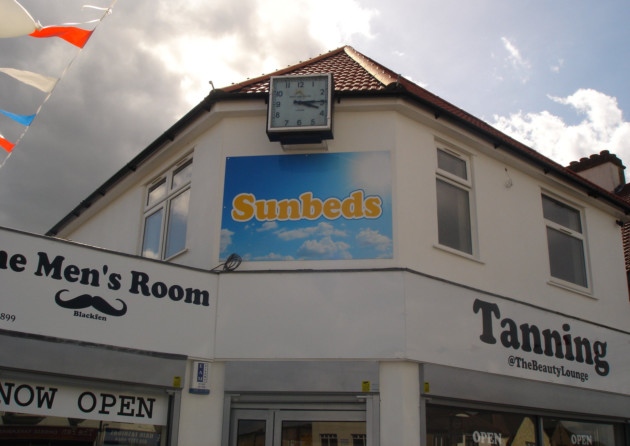
The former builders’ merchant Homepride, which had closed, re-opened as The Beauty Lounge in April 2016.

Bexley Times reported on 6 June 2016: “A clock dating back to the 1940s has been put back into working order as a new business moved in. The Beauty Lounge moved into the former home of Homepride Builders on Blackfen Road at the turning for Sycamore Avenue earlier this year.

Beauty Lounge_Bexley Times_June 2016

As locals showed concern for the building’s heritage, the new owners continued their redevelopment of the site by not only preserving the clock, but by getting it back in working order. Owner Claire Cousins said: “The clock has been there for so long and it has become quite a feature for everyone in the town. Once we took over there were people commenting on social media asking what would happen to the clock, so we told them that were renovating it with the rest of the building. It has the same clock face as before but changed the workings so that it can tell the time.”

The business owner, who has lived in Sidcup for nearly 30 years, originally opened the beauty parlour along the same road in 2013, but moved in to the new shop in April.

Sidcup’s Great War: A Living Pageant

I am helping to organise an event which is taking place in Sidcup High Street on 18 June 10am-4pm. Its aim is to commemorate the anniversary of the First World War and explore what life was like in Sidcup at that time. Sidcup’s Great War: a Living Pageant will have street theatre, live music, school choirs, displays, stalls by a variety of local history/interest and military organisations, talks on aspects of the First World War and concluding with a service at the War Memorial. The event has brought together a large number of organsations, colleges, schools and churches and lots of the shops and pubs are getting involved. There will be plenty to keep the whole family interested, including a Family Poppy Trail which will invite you to walk around the town and discover the story of Sidcup’s Home Front 100 years ago. So please put the date in your diaries and come along! For more info and to keep up with news see www.lam-sid-lhs.co.uk

Facebook: Sidcup’s Great War Pageant. Twitter @Sidcup GWP